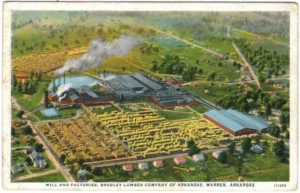
Mill heritage and modern commissions are the same shop conversation at different scales. Bradley Lumber Company of Warren taught Arkansas how to think in oak volume, drying, and plant discipline; Bradley Brand Furniture still builds named series and design-to-spec packages from that continuity. This essay is not nostalgia for postcard mills — it is how Warren-era habits show up when a designer, a SNF wing, or a homeowner asks for furniture that will still read as one system in ten years.
Read heritage depth on /heritage/, Bradley Lumber Company of Warren, flooring and furniture stock to heirloom tables, and historic mill photos. Start commissions at /commission/ and custom / millwork.

What the mill taught that still ships
Large mills forced honesty about species mix, grade, drying, and throughput. Furniture shops that forget those lessons romanticize “solid wood” while ignoring moisture and repeatability. What survived into our craft — including Potlatch-era continuity notes in Potlatch era and what survived — is less about logos and more about stock discipline: oak that behaves, frames that rack less, finishes matched to use.
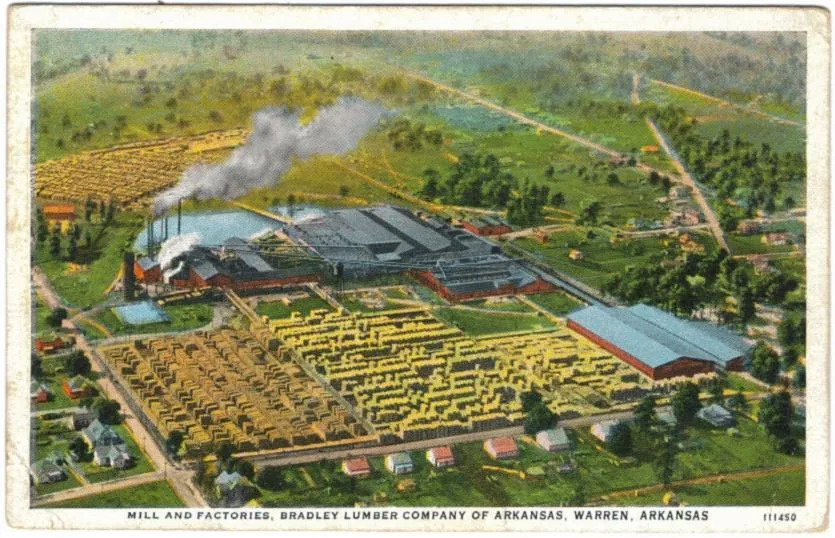
Public-record essays such as 1901 vs 1903 keep dates honest; plant photographs keep scale honest. Neither replaces a tape measure on a modern job. Heritage is the why; the commission packet is the how.
Named series are the mill habit translated to catalogue geometry: Lumberjack, Gathering, Saline Creek islands, RattleSnake, Moro. Commissions are the mill habit translated to drawings: matched runs, odd footprints, millwork adjacency. Both paths assume hardwood is a material with rules, not a backdrop for lifestyle copy.
Commissions that inherit mill logic
When a brief asks for 500+ units of justifiable scale, planer-mill capacity can enter the conversation — a published capability, not a marketing flourish. Design-to-spec engineering at $150/hr covers drawings and optimization toward linear millwork, CNC, or related workflow. That is how institutional packages — Medilodge, ConvoCare and BarceloCare communities, Delta Memorial, and related $50k–$500k work named in our credibility file — get durability without inventing fake homeowner testimonials.
Mill logic also means saying no. A live-edge romance that will not survive corridor cleaners, or a reclaimed face without structure, fails the same test a grading yard would have failed a century ago. See custom jobs portfolio, live-edge and walnut specials, and healthcare durability for how we keep proof disciplined.
Commercial rooms such as Texas Best Smokehouse and Purple Pig Cafe show the same maker under different cleaning loads. Residential commissions stay quieter in public copy: we specify drawings and finishes; we do not invent star-rated homeowner quotes to pad a heritage bridge essay.
Heritage pages vs commission packets
Heritage essays explain timeline, flooring-to-furniture stock stories, and how to read plant photographs. Commission packets need tape measures, cleaner notes, decision rights, and dates — the quote checklist. Do not send only a mill postcard and expect a nurses’ station drawing. Do not skip heritage either if you care why Arkansas oak is the house language.
Sibling history domains and Ken Burns–style mill narrative stay history-first; this site’s job is furniture authority plus catalogue. Sparse cross-links, different IA — no doorway farms. Shop process today is still mill → plane → sand → assemble → finish: shop process. Unfinished joinery remains the proof habit: joinery you can see.
Kitchen and dining as living inheritance
Why Arkansas hardwood still matters in the kitchen is not a slogan — it is species, finish, and worktop honesty under heat and water. Series islands and dining sets carry that inheritance into rooms that never needed a custom set. Browse Arkansas hardwood in the kitchen, kitchen islands, and dining when the brief is residential and catalogue-shaped.
When the architecture will not bend — matched paneling, handrail, odd spans — commissions inherit mill thinking as drawings instead of SKUs. That is the bridge, not a contradiction. Measuring habits from the island essay still apply: path, overhang, and door swing before romance.
Series as the bridge
Most buyers should start in series. Catalogue dining, islands, living, and bedroom groups already carry mill-era oak thinking into rooms that do not need custom drawings. Leave series when architecture, counts, or matched millwork demand it — named series vs custom and how a commission works.
Browse /collection/, read unfinished joinery, then decide. Mill heritage earns trust; modern commissions earn dimensions. Both belong in the same Arkansas hardwood shop — Warren memory, Wilmar production, rooms that still need honest oak.