Kitchen furniture fails in public. Edges take knives and elbows. Tops take heat, water, and cleaners. Bases take vacuum bumps and kids on stools. If the hardwood cannot hold up under that load, the room tells on it. Arkansas hardwood — especially the oak language Bradley Brand builds in Wilmar — still matters in the kitchen because the material history and the shop practice are the same argument: dense, workable stock that can be milled, joined, finished, and lived with.
This note sits beside our oak species and grain essay and the Saline Creek island work. It is not a tourism brochure. It is a buying brief for people specifying islands, gathering tables, and casework that must survive daily food prep.

Why species and origin still show up in the room
Softwood and thin veneers can look fine in a catalog shot. Kitchens punish them. Solid hardwood lets you sand a scar, re-oil a face, and keep the piece in service. Oak in particular takes joinery, holds fasteners, and reads as furniture rather than cabinetry filler when the proportions are honest. Arkansas bottoms and upland stands historically supplied mills in this region; our shop continues to build from solid stock with that expectation of repairability and presence.
When we talk about Bradley Lumber Company of Warren, we are pointing at place and craft lineage — mill culture, hardwood handling, furniture stock — not inventing unbroken legal succession for Bradley Brand Furniture, LLC. Buyers should judge the piece in front of them: grain, joinery, finish chemistry, and how the shop answers questions.
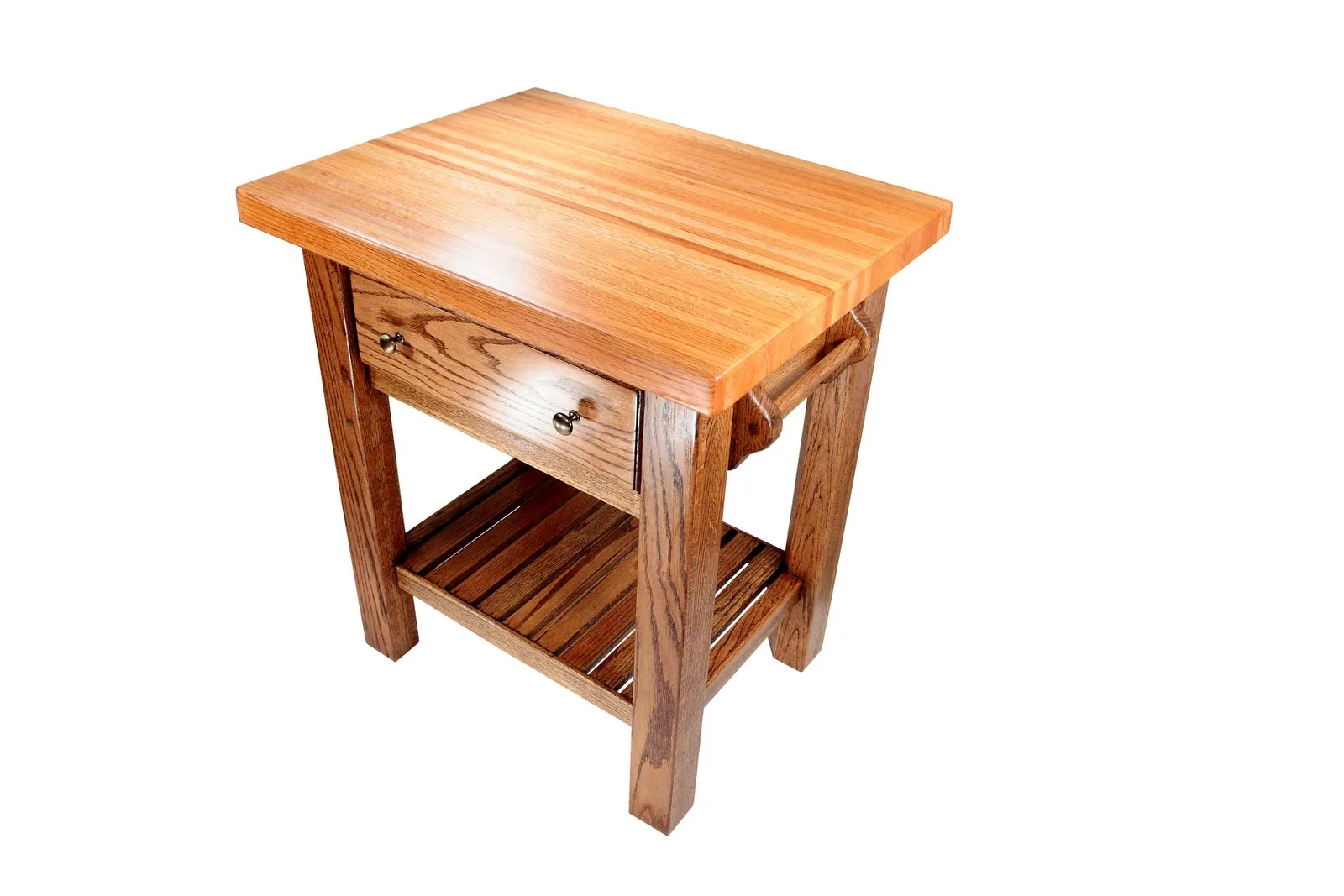
Kitchen use cases that expose weak wood
Working islands. Tops take cutting boards, hot pans (with pads), and standing prep. Bases take doors, drawers, and knee space. A solid top you can maintain beats a film that hides cheap substrate until it chips.
Gathering tables. Dining height and stool clearance matter as much as species. Hardwood aprons and legs that stay square under seasonal movement are the quiet proof.
Casework near water. Sink-adjacent pieces need finish systems matched to cleaners — see conversion varnish vs oil — and wood thick enough that a ding is character, not a core breach.
How to specify without mythology
Ask for species, grain orientation on the working face, finish system, and assembled shipping expectations. Send room photos and clearances with your quote checklist. If you need a form outside the named series, use the commission path. We quote from Wilmar; we do not invent catalog prices on the page.
Arkansas hardwood still matters because kitchens are long-term rooms. The right oak piece should still be the most used surface in the house a decade later — maintained, not replaced.
What buyers confuse with “local hardwood”
Labels like “solid wood” and “hardwood” are necessary but not sufficient. Particle core with a thick face can photograph like oak until a chip exposes the sandwich. Import mixed-hardwood sets can be dense and still poorly joined. The Arkansas argument is not nationalism for its own sake — it is accountability: a shop you can call, a finish system you can name, and a piece that can be repaired in the same grammar it was built.
Institutional work sharpens the point. SNFs and clinics wipe hard and host traffic that residential kitchens only approximate on holidays. When we reference field projects in the $50k–$500k band on the heritage page, the through-line is durability under cleaning protocols — the same reason kitchen islands in private homes should not be styled like temporary furniture.
Grain, movement, and the kitchen climate
Kitchens swing humidity with cooking and seasons. Solid tops move across the grain; good joinery and finish choice anticipate that. Edge-grain butcher faces and properly oriented panels behave differently than decorative book-matched veneers glued to unstable cores. Our craft pages on materials and process exist so you can see unfinished joinery and shop sequence — buyer proof, not mood boards.
If you are comparing a Saline Creek island to a big-box cart unit, compare service life and repair path, not only first-day shine. Re-oiling a working face is maintenance. Replacing a swollen particle top is waste.

For series language that already lives in kitchens — islands, gathering tables, stools — start in the collection. For odd footprints, go commission. Either path, Arkansas hardwood is the medium; the room’s use is the brief.

