Pedestal tables solve a quiet problem four-leg tables cannot: clear floor under the apron, easier chair slide, and a center of gravity that reads architectural instead of four corner posts. In the Bradley Brand dining map, the 3730–3770 pedestal band is the folder language for that solution — solid oak dining forms where the base does the structural talking.
This deep-dive sits beside Lumberjack and Gathering. Start from /collection/dining/; use this essay for clearance logic, when pedestal beats trestle or four-leg, and when a live-edge or walnut special belongs in commission instead.

What the 3730–3770 band means
Photo-folder and catalogue inventory group pedestal tables under the 3730–3770 range, with 3760 appearing as a named pedestal table folder. Treat those numbers as series/archive identifiers — useful for matching historic shop photos and wholesale sheets — not as a promise that every integer in the band is a current web SKU. The buying question is simpler: do you need a center-base oak dining table with furniture-grade joinery and finish?
Pedestal construction concentrates load into a central column or clustered base, then spreads it at the floor with feet or a platform. That geometry frees chair arcs at the corners and reduces the “barked shin” problem of corner legs in tight dining rooms. It also demands careful engineering: racking resistance, top attachment, and finish durability at the base where vacuum cleaners and shoes hit first.
When pedestal is the right brief
- Smaller dining rooms where four corner legs steal chair positions.
- Round or softened rectangular tops that want radial seating.
- Households that slide chairs constantly — kids, daily homework, accessible seating.
- Rooms that already have heavy case goods; a quieter base keeps visual weight centered.
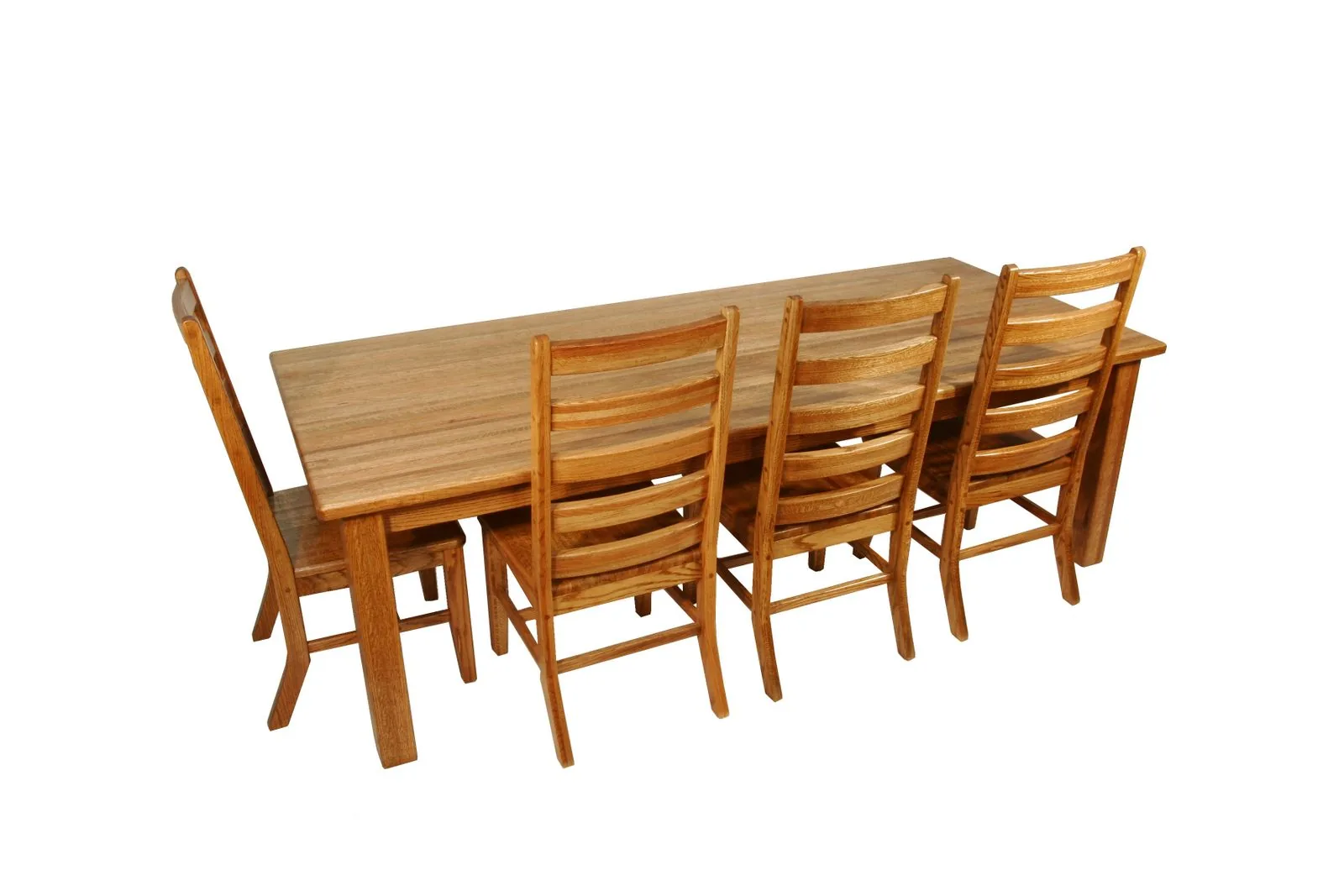
Choose Lumberjack-style four-leg or trestle language when you want a long rectangular set with matching chairs and buffet adjacency. Choose Gathering when height and stool posture dominate. Choose pedestal when clearance and centered form dominate. Mixing a pedestal table with Lumberjack chairs can work if seat height and finish system match — confirm samples rather than assuming.
Engineering and finish notes
A pedestal fails quietly if the column-to-top connection creaks or if the feet print finish onto floors. Ask about attachment hardware, leveling, and finish system at the base. Conversion varnish vs oil still applies — kitchen-adjacent dining often wants the more cleanable film; oil systems need a care rhythm. Keep bleach-test lessons and the care guide in the conversation.
Species choice remains red or white oak unless you commission otherwise. Grain orientation on the top should be discussed like furniture stock — not like a wallpaper sample. That is Warren’s mill habit showing up in a dining SKU: thickness and yield before romance. Heritage context lives on /heritage/; shopping context stays on the dining hub.
Pedestal vs live-edge and walnut specials
Series pedestals are repeatable. Live-edge slabs and walnut specials are not — they are commission territory when the top’s organic edge or multi-species story is the point. If series oak is enough, stay in 3730–3770 language. If you need a one-off slab, open /commission/ with photos and dimensions; do not force a series folder to absorb a unique tree.
Institutional and hospitality rooms sometimes want pedestal bases for accessibility and cleaning under the top. That is a design-to-spec path with clearances and finish callouts — related to our healthcare durability brief, without inventing project names beyond the published proof list.
Room planning with a centered base
Place the pedestal where chair arcs are even. Avoid parking the base so one guest’s knees hit a foot wing while another floats in empty air. Round tops forgive uneven guest counts; rectangles still need place-setting length. Rugs should clear the feet so vacuum edges do not chew finish. If the room also holds a Moro sofa table or RattleSnake occasional pieces, keep finish temperature consistent across living-to-dining transitions — browse living and Moro as adjacent language, not as competitors to the pedestal.
Historic mill literacy does not pick your pedestal diameter, but it explains why we still insist on solid hardwood sections. Furniture-stock thinking shows up in top thickness and base massing. When a pedestal looks skinny in a photograph, ask about real dimensions — Moser-class buyers care about the millimeters that prevent racking.
For bedroom or case-goods adjacency in open plans, do not let a heavy pedestal visually collide with a tall wardrobe line. Open plans need hierarchy: one dominant wood mass per view cone. Pedestal dining can be that mass if bedroom case goods stay quieter — or the reverse.
How to specify and quote
Bring finished table height, top diameter or length/width, chair count, rug clearance, and preferred finish. Measure doorway diagonals for assembled shipping — our shipping essay sets expectations for USA pieces that are not flat-pack. Use the quote checklist so photos and dimensions arrive complete.
Browse dining, compare Gathering and Lumberjack, and read series vs custom if your room fights catalogue geometry. Pedestal tables earn their keep when the floor under the apron matters as much as the grain on top — Moser specificity applied to a centered oak base.


