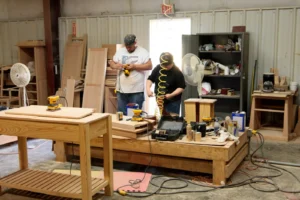
Gathering height is hospitality engineering in oak: a taller square table, paired stools with real joinery, and a room that wants standing conversation as much as seated meals. The Gathering table and stool set from the catalogue — models in the 3017 / 3018 family — is one of the clearest expressions of that idea in the Bradley Brand dining map.
This essay is a series deep-dive for buyers who already know Lumberjack’s dining language and want the taller sibling. Start from /collection/gathering/ and the broader dining hub; return here for proportion, finish, and when to commission instead.

What the catalogue specifies
Catalogue language for Gathering describes a 42-inch square table with plank or butcher-block top options, offered in red or white oak, shipping assembled or legs-off depending on the job. The matching Gathering stool is called out for mortise-and-tenon construction — not a screw-together café stool pretending to be furniture. Those details matter more than lifestyle adjectives: square footprint for conversational clusters, height for gathering, joinery you can inspect.
Butcher-block vs plank is not a fashion toggle. Edge-grain or related block construction changes how the top takes knives, heat, and seasonal movement; plank tops read more as dining furniture. If you are comparing top constructions across the line, keep end-grain vs edge-grain and the butcher-block lineage essay nearby — Gathering inherits that materials conversation even when the room is dining, not kitchen island.
How Gathering sits beside Lumberjack and pedestals
Lumberjack owns the classic seated dining set — table, chairs, buffet adjacency. Pedestal tables in the 3730–3770 band solve center-base clearances and softer foot traffic under the apron. Gathering solves a different brief: people standing with drinks, homework sprawl at counter-adjacent height, or a kitchen-dining overlap where stool seating is the default.
Choose Gathering when the room’s primary posture is upright hospitality. Choose Lumberjack when long seated meals dominate. Choose pedestal when you need knee room without four corner legs. Mixed rooms happen; just do not force one SKU to answer every posture. Series vs custom guidance in named series vs custom still applies if your footprint is not square or your stool count is institutional.

Stools as furniture, not afterthoughts
A Gathering stool fails if it wobbles, racks, or treats the seat as disposable upholstery over a weak frame. Mortise-and-tenon rails and solid oak legs are the catalogue promise; finish system and floor glides are the practical follow-through. For commercial-adjacent homes — open kitchens that host weekly — ask the same durability questions we publish for institutional work: cleaners, scuff edges, and replacement path if one stool takes the hit.
We do not invent testimonials here. We point to construction language and to process essays that show unfinished frames under joinery you can see. If your project needs matched stool counts at scale, that is a commission conversation with drawings — not a lifestyle gallery.
Planning the room
Square tables need clear circulation on all four sides. Measure stool overhang, aisle to island, and the swing of nearby appliances before you fall in love with the height. Our measuring essay for islands and tables walks the tape-measure habits; Gathering simply shifts the vertical datum. If the island already owns counter height, confirm Gathering will not fight it — sometimes the right move is a seated Lumberjack table and a working island, not two tall surfaces competing.
Finish choice should follow use. Conversion varnish vs oil is a bleach-test and maintenance conversation; kitchen-adjacent Gathering tops often want the more cleanable system. Read conversion varnish vs oil and the care guide before you lock a sample.
Finish samples and real-world hosting
Gathering tops live near food. That means heat rings, citrus, and cleaning products show up faster than they do on a formal seated table used twice a month. Ask for a finish sample you can leave under a wet glass overnight; compare it to the bleach-test lessons we already publish. Oil can look quieter; film finishes often forgive hosting better. Neither is “more authentic” — authenticity is naming the system and maintaining it.
If the Gathering set shares a room with a Saline Creek or Cossatot island, align undertones so the oak does not look like two unrelated purchases. Creek-series islands and Gathering stools can coexist; they should not fight. Browse kitchen islands and Saline Creek when the kitchen is the true host, then place Gathering as the conversational satellite.
Shipping assembled or legs-off is a logistics choice, not a quality downgrade. Legs-off can save a doorway; assembled saves an afternoon. Read shipping expectations before the truck is booked, and photograph the path from curb to room for the quote packet.
When to stay in series vs commission
Stay in Gathering series when 42-inch square, catalogue top options, and standard stool geometry fit. Commission when you need rectangle gathering height, integrated power, matched institutional counts, or a wood not on the standard oak path. Heritage context on /heritage/ explains why Warren still thinks in solid hardwood; it does not change your tape measure.
For room-use pairing — stool counts, gathering vs seated hosting — continue into the dining-that-hosts essay. For shopping paths, open Gathering, compare Lumberjack, and send dimensions through contact / quote when you are ready.